
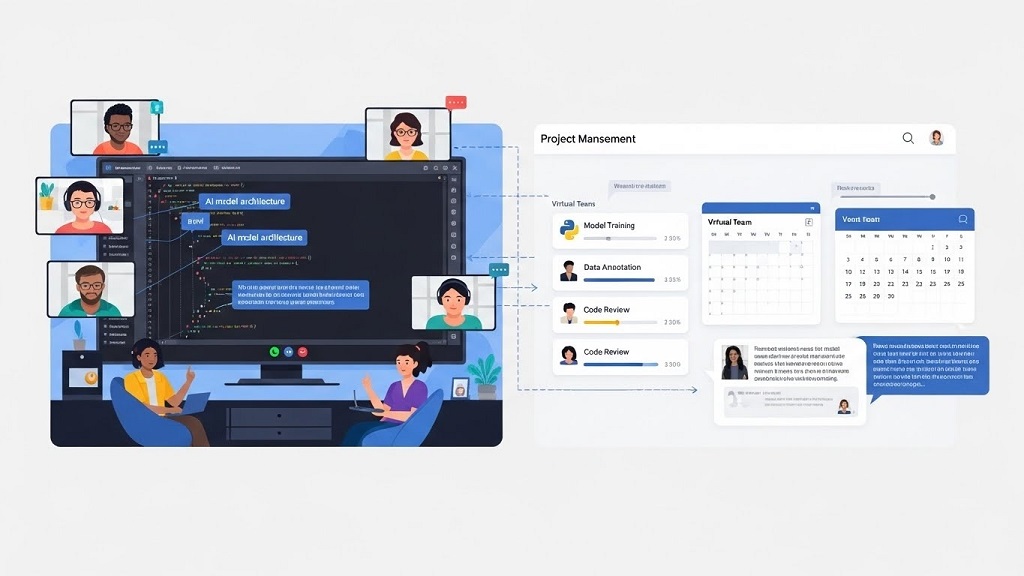
Remote AI software development teams are distributed groups of AI engineers, data scientists, and product specialists who build, train, and deploy artificial intelligence systems while working from different locations. These teams rely on digital collaboration tools instead of physical offices.
Over the last few years, companies have rapidly adopted this model. According to multiple industry reports, organizations using distributed engineering teams report faster hiring cycles, access to global talent, and lower operational costs. AI development, in particular, benefits from this approach because expertise in machine learning, NLP, and data engineering is scarce and globally spread.
But managing remote AI engineers is not the same as managing traditional software teams. AI work involves experimentation, long training cycles, data dependencies, and ethical considerations. Without the right structure, remote AI projects often face delays, misalignment, and quality issues.
This guide explains best practices for managing remote AI software development teams using real-world experience, practical frameworks, and proven workflows. Each section answers a specific question, starts with a direct snippet-ready answer, and then expands with actionable steps you can apply immediately.
What are the biggest challenges in managing remote AI software development teams?
Short answer: The biggest challenges are communication gaps, unclear goals, data access issues, inconsistent workflows, and difficulty measuring AI progress remotely.
AI projects are different from standard software development. Code output alone does not define success. Models need training, validation, monitoring, and iteration. When teams are distributed, these challenges become more visible.
- Lack of shared context around data and models
- Delayed feedback loops during experimentation
- Time zone differences affecting collaboration
- Difficulty tracking model performance and ownership
- Security and compliance risks with remote data access
Ignoring these challenges leads to wasted compute costs, missed deadlines, and unreliable AI systems.
How should you structure distributed AI teams for better accountability?
Short answer: Assign clear ownership by role, not location, and organize teams around AI outcomes instead of tasks.
High-performing distributed AI teams follow a clear structure. Each member knows what they own and how success is measured.
Recommended team structure
| Role | Primary Responsibility |
|---|---|
| AI Product Owner | Defines use cases, success metrics, and business goals |
| Machine Learning Engineer | Model training, optimization, deployment |
| Data Engineer | Data pipelines, quality, access control |
| Software Engineer | System integration and APIs |
| MLOps Engineer | CI/CD, monitoring, scalability |
Each role should have a single owner per model or pipeline. This prevents confusion and speeds up decision-making.
How do you set clear goals for remote AI engineers?
Short answer: Use outcome-based goals tied to measurable AI metrics, not vague development tasks.
Traditional task lists fail in AI projects. Instead, align teams around measurable outcomes.
Examples of strong AI goals
- Increase model accuracy from 82% to 88%
- Reduce inference latency below 150ms
- Improve data coverage for underrepresented classes
- Lower cloud training cost by 20%
Clear goals give remote AI engineers autonomy while keeping work aligned with business impact.
What communication practices work best for distributed AI teams?
Short answer: Combine async documentation with short, focused sync meetings.
Remote AI software development teams work best when communication is intentional.
Best communication practices
- Daily async updates instead of long meetings
- Weekly model review sessions
- Written experiment logs for every model change
- Clear decision records for data and architecture choices
This approach reduces interruptions while maintaining transparency.
How do you manage data access and security for remote AI teams?
Short answer: Centralize data access, enforce permissions, and audit usage regularly.
AI teams depend on data. Remote access increases risk if not controlled properly.
Security best practices
- Role-based access control for datasets
- Encrypted storage and transmission
- Limited local downloads of sensitive data
- Regular access reviews
These steps protect sensitive information while enabling productivity.
How do you track performance in remote AI software development teams?
Short answer: Track model metrics, delivery milestones, and system reliability together.
Measuring only output lines of code does not work for AI.
Key performance indicators
- Model accuracy, precision, recall
- Deployment frequency
- Experiment success rate
- Incident response time
Tracking these metrics keeps distributed AI teams aligned and accountable.
What tools are essential for managing remote AI engineers?
Short answer: Use integrated tools for communication, version control, experimentation, and deployment.
Tool categories
- Project management tools for sprint planning
- Version control for code and models
- Experiment tracking platforms
- Monitoring dashboards
Tool consistency matters more than tool quantity.
How can leaders build trust in distributed AI teams?
Short answer: Trust grows through transparency, autonomy, and consistent feedback.
Remote AI engineers perform best when they feel trusted.
- Share business context openly
- Avoid micromanagement
- Recognize impact, not hours worked
Trust directly improves innovation and retention.
What real-world results show remote AI teams can succeed?
Short answer: Companies using structured remote AI teams report faster delivery and lower costs.
One mid-sized SaaS company transitioned to a fully distributed AI team across three regions. By standardizing experiment tracking and async reviews, they reduced model deployment time by 35% and cut cloud waste by 22% within six months.
This outcome highlights the importance of structure over location.
What is the best way to manage remote AI software development teams long term?
Managing remote AI software development teams requires more than allowing people to work from home. It demands clear ownership, outcome-driven goals, strong documentation, and reliable measurement.
Distributed AI teams succeed when leaders focus on systems instead of supervision. Clear processes, secure data access, and consistent communication turn distance into an advantage.
If you apply the practices covered in this guide, your team can build reliable AI products, scale faster, and attract top global talent without sacrificing quality.
Call to Action: If you are building or scaling distributed AI teams, start by auditing your current workflows today. Identify one process to document, one metric to clarify, and one communication habit to improve. Small changes compound fast.
Frequently Asked Questions
What skills are essential for remote AI engineers?
Remote AI engineers need strong fundamentals in machine learning, data handling, and software engineering. Communication and documentation skills are equally important.
How do you onboard new members into distributed AI teams?
Use structured onboarding with clear documentation, access checklists, and small starter projects to build confidence quickly.
Can remote AI teams handle sensitive data?
Yes, with proper access control, encryption, and auditing, remote teams can securely manage sensitive datasets.
How often should remote AI teams meet?
Weekly sync meetings combined with daily async updates usually provide the right balance.
How do you prevent burnout in remote AI software development teams?
Set realistic deadlines, encourage breaks, and focus on outcomes rather than constant availability.
Is productivity higher in distributed AI teams?
Studies show productivity improves when teams have autonomy, clear goals, and fewer interruptions.
Related Topics: The Rise of Server less Computing: Why Businesses Are Ditching Traditional Infrastructure
Related Topics: Demystifying SaaS in Cloud Computing: Your Ticket to Streamlined Software Solutions