The noise cancelling headphone market has become so saturated that even informed buyers end up with the wrong pair — not because the headphones are bad, but because “noise cancelling” encompasses a 70% performance range between budget ANC that barely dulls a fan to Bose ANC headphones that make an airplane cabin sound like a library. Noise cancelling headphones fail buyers when the ANC strength doesn’t match the noise environment, when comfort duration doesn’t match wearing time, or when features like multipoint connectivity are absent for workflows that require them. The wrong purchase isn’t always the cheapest option — it’s frequently a $300 headphone with the wrong noise cancellation profile for your specific daily noise challenges.
Bose ANC headphones represent the current benchmark for active noise cancellation performance against which all competitors are measured. Active noise cancellation (ANC) uses external microphones to sample ambient sound, then generates inverse sound waves through the headphone drivers to neutralize incoming noise before it reaches your eardrums. The technology works best against consistent low-frequency sounds and varies dramatically in effectiveness between brands, price tiers, and specific noise environments.
This guide identifies the specific mistakes that lead to wrong ANC purchases and gives you the evaluation framework that matches headphone capabilities to your actual noise environment — not to marketing claims.
What Are the Most Common Noise Cancelling Headphone Buying Mistakes?
The five biggest mistakes: assuming all ANC performs equally regardless of price, buying based on ANC alone while ignoring comfort for your wearing duration, choosing in-ear ANC when over-ear would serve your noise environment better, ignoring multipoint connectivity for multi-device workflows, and testing headphones in quiet stores instead of your actual noisy environment.
Mistakes ranked by regret impact:
| Mistake | Why It Happens | Consequence | Prevention |
|---|---|---|---|
| Assuming all ANC is equal | “Noise cancelling” label exists at $30 and $400 | Budget ANC reduces noise 30–40%; premium reduces 75–90%. Massive gap. | Research ANC tier — budget/mid/premium match to your noise severity |
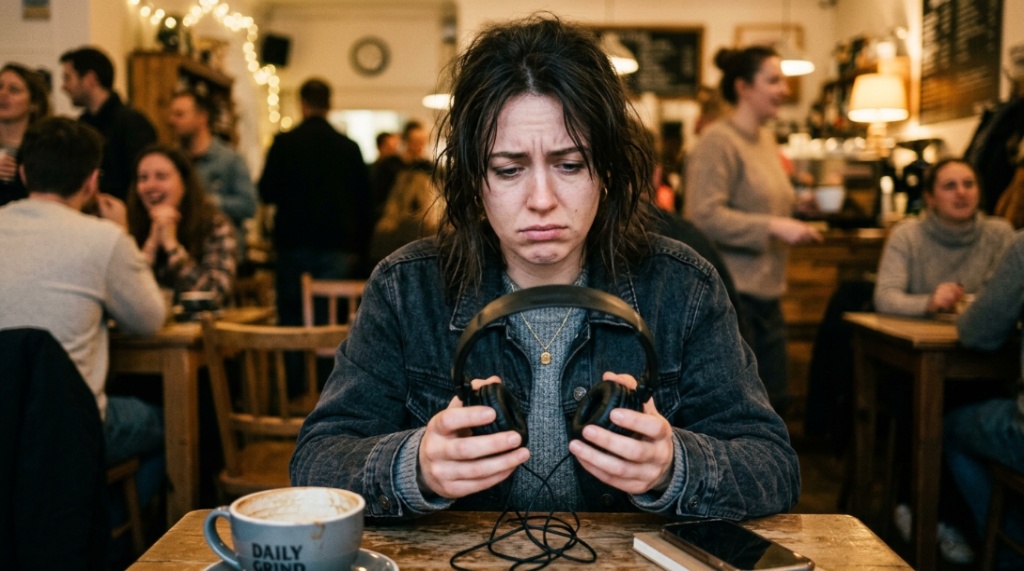
| Ignoring comfort duration | ANC spec focus overshadows fit testing | Perfect ANC in headphones you remove after 90 minutes due to discomfort | Test comfort for YOUR target duration (2hrs? 6hrs? 10hrs?) |
| Wrong form factor for environment | Preferring earbuds for portability in high-noise situations | In-ear ANC caps at ~25dB reduction; over-ear achieves 30–35dB. Office vs. plane is different. | Over-ear for extreme noise (planes, construction); earbuds for moderate noise (office, café) |
| Skipping multipoint | Not realizing need until daily use | Constant Bluetooth switching between phone and laptop disrupts workflow | Require multipoint if you use phone + computer daily |
| Testing in wrong environment | Store demos in quiet showrooms | ANC that seems good in silence reveals weakness in your actual noisy space | Buy with 30-day returns; test in YOUR environment for 1 week |
How Do You Determine What ANC Strength You Actually Need?
Match ANC tier to your primary noise environment: moderate ambient noise (office, home, café) needs mid-range ANC. High persistent noise (airplane, train, bus) needs premium ANC from Bose or Sony flagships. Variable loud noise (construction-adjacent, city streets) needs adaptive ANC that adjusts automatically to changing conditions.
ANC strength requirements by environment:
- Quiet office with occasional disruption (40–55dB ambient): Mid-range ANC ($100–$200) handles this adequately. You need just enough cancellation to smooth out conversation peaks and HVAC hum. Premium ANC is overkill here.
- Open-plan office with constant chatter (55–70dB): Upper-mid to premium ANC ($150–$350) recommended. Consistent voice-frequency noise is the hardest type to cancel — only better algorithms handle it well. Bose and Sony flagships excel here.
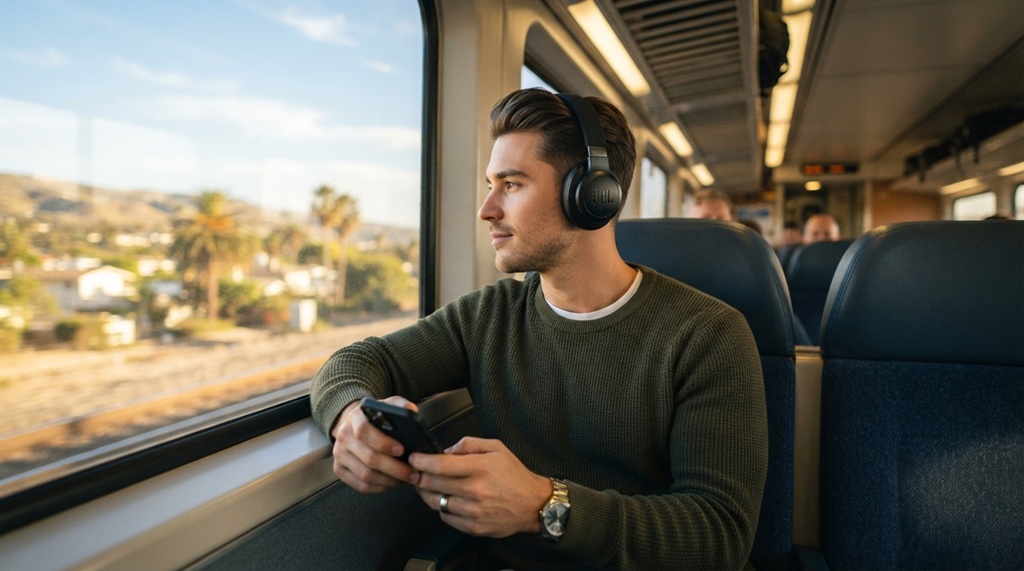
- Public transit (65–80dB engine + voices): Premium ANC required ($250–$400). The combination of low-frequency engine drone and variable passenger noise demands the best processing. Bose QuietComfort series is specifically tuned for transit environments.
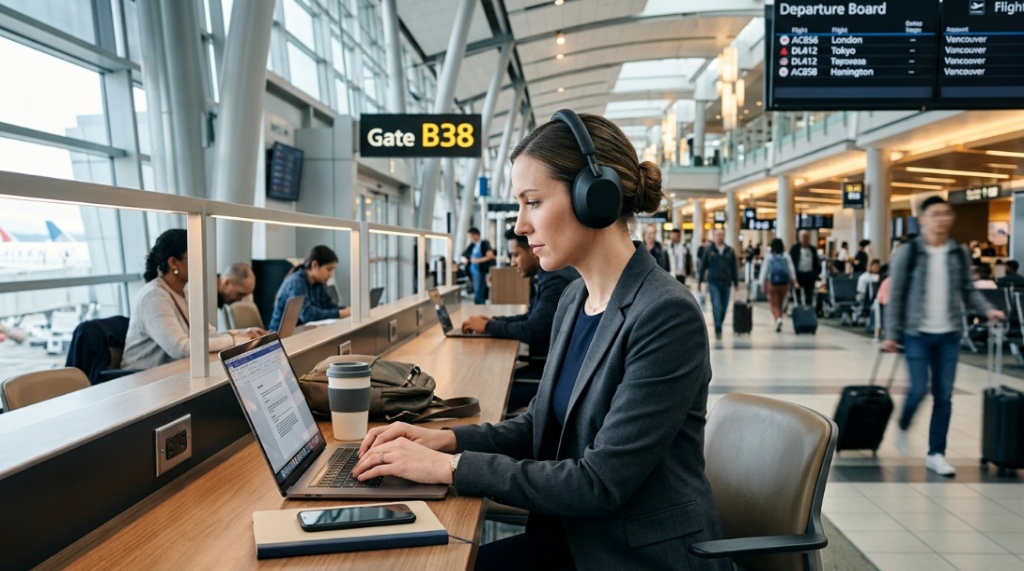
- Aircraft cabin (75–85dB constant): Maximum ANC essential. Only flagship models (Bose QC Ultra, Sony WH-1000XM5) reduce this enough for comfortable listening. Budget ANC is essentially useless at this noise level.
- Variable environments (switching between quiet and loud): Adaptive ANC that auto-adjusts is critical. Bose’s Aware mode and Sony’s Adaptive Sound Control detect environment changes and adjust cancellation strength automatically — preventing the manual mode-switching that disrupts workflow.
What’s the Real Difference Between Budget and Premium ANC?
Budget ANC ($50–$150) reduces ambient noise by 15–20dB — noticeable but not transformative. Premium ANC ($250–$400) from Bose and Sony reduces noise by 28–35dB — genuinely approaching silence in most environments. The gap between these isn’t incremental — it’s the difference between “slightly quieter” and “I can’t hear the airplane engine.”
Performance tier breakdown:
- Budget ANC ($50–$150): Handles constant low-frequency noise adequately (fan, HVAC). Struggles with mid-frequency noise (voices, music). Provides 15–20dB total reduction. Feels like “turning down the volume” on your environment by 40–50%.
- Mid-range ANC ($150–$250): Better processing handles both low and some mid-frequency noise. 20–25dB total reduction. Noticeable improvement over budget. Handles office and commute environments adequately. Examples: Sony WH-CH720N, Soundcore Space One.
- Premium ANC ($250–$400): Best-in-class processing handles the full frequency spectrum with adaptive algorithms. 28–35dB total reduction. Creates genuine perceived silence in most environments. Handles aircraft, transit, and extreme noise. Examples: Bose QuietComfort Ultra, Sony WH-1000XM5.
For comprehensive ANC performance testing across current models, the top-rated Bose QuietComfort headphones review provides noise reduction measurements in real-world environments rather than lab conditions.
Should You Choose Over-Ear or In-Ear Noise Cancelling Headphones?
Over-ear ANC headphones provide 25–35% more total noise reduction than in-ear ANC earbuds because they add 15–20dB of passive isolation from the physical ear cup seal. Choose over-ear for maximum noise cancellation needs (flights, loud transit) and in-ear for portability with adequate cancellation (office, moderate commute).
Form factor comparison for ANC:
- Over-ear ANC (maximum cancellation): Physical ear cup creates 15–20dB passive barrier BEFORE ANC activates. Combined with electronic ANC: 28–35dB total. Best for aircraft, trains, and any environment above 70dB. Trade-off: larger, heavier, warmer in hot conditions.
- In-ear ANC (portable cancellation): Sealed ear tip creates 20–25dB passive barrier. ANC adds 10–15dB electronic reduction. Total: 25–30dB. Sufficient for office, café, and moderate commute noise. Excellent portability. Trade-off: less total cancellation, comfort limited to 3–4 hours for most users.
- On-ear ANC (compromise — often worst of both): Smaller cups don’t fully seal around ears, leaking noise around pad edges. Passive isolation only 8–12dB. ANC must work harder to compensate. Often underperforms both over-ear and in-ear despite similar pricing.
The consistent recommendation from audio professionals: if noise cancellation is your PRIMARY buying motivation, over-ear is the correct form factor. Earbuds compete when portability matters equally or more than maximum silence.
How Important Is Adaptive ANC for Daily Use?
Extremely important if your day involves moving between quiet and loud environments. Adaptive ANC automatically adjusts cancellation strength based on ambient noise level — full cancellation on a loud bus, reduced cancellation in a quiet office, transparent mode when walking outdoors. Without it, you’re manually switching modes 10+ times daily.
Adaptive vs. fixed ANC in daily scenarios:
- Morning walk to transit (low→high noise): Adaptive increases ANC gradually as you enter the noisy station. Fixed ANC stays at whatever level you set last night — either too strong (blocking traffic you need to hear) or too weak (insufficient for the train).
- Arriving at office (high→low noise): Adaptive reduces ANC as your quiet office doesn’t need it, improving battery life and removing the slight “pressure” feeling of unnecessary ANC. Fixed maintains maximum cancellation wastefully.
- Colleague approaches (sudden need for awareness): Best adaptive systems detect voice direction and reduce ANC on that side. Fixed requires you to manually activate transparency mode — by which time you’ve already missed their first words.
Bose’s Aware mode and Sony’s Adaptive Sound Control lead this category. Both use external microphones to continuously monitor environment and adjust ANC parameters in real-time without user intervention.
What ANC Features Actually Matter vs. Marketing Fluff?
Features that matter: adjustable ANC levels (not just on/off), transparency mode quality, adaptive auto-adjustment, and wind noise reduction for outdoor use. Marketing fluff: “AI-powered ANC” without measurable improvement, extreme maximum PSI ratings, and “personalized ANC” that rarely outperforms default settings meaningfully.
Genuinely valuable ANC features:
- Adjustable levels (essential): At least 3 levels (off, moderate, full) lets you match cancellation to environment. Full ANC in a quiet room feels unnecessarily pressurized. Moderate ANC saves battery and feels more natural for mild noise.
- Quality transparency mode (essential): How natural does the world sound when you activate pass-through? Bad transparency sounds robotic and distorted. Good transparency (Bose, Apple) sounds nearly like wearing nothing. Critical for quick conversations without removing headphones.
- Wind noise reduction (important for outdoor use): Wind across external ANC microphones creates terrible rumbling artifacts in basic implementations. Premium models use mesh-covered mics and algorithmic wind detection to minimize this — essential for walking commuters and runners.
- Conversation detection (nice-to-have): Automatically activates transparency when you start speaking. Bose and Sony both offer versions. Convenient but not essential — you can manually toggle transparency in 1 second.
How Do You Test ANC Headphones Before Committing to a Purchase?
Buy from a retailer with 30-day returns, then test in your three noisiest daily environments during the first week. Don’t evaluate in your living room — evaluate on your commute, in your office, and during your noisiest regular activity. If ANC satisfies in your worst-case environment, it’ll handle everything else.
Real-world testing protocol:
- Day 1–2 (commute test): Wear during your noisiest transit segment. Can you comfortably listen to podcasts at moderate volume without competing against environment? If yes, ANC strength is sufficient for your commute.
- Day 3–4 (office/work test): Wear during your focused work time. Does ANC eliminate enough disruption for concentration? Can you hear important sounds (phone ring, name being called) through transparency mode when needed?
- Day 5–7 (comfort endurance): Wear for your typical daily duration. Does comfort hold through your entire wearing period? Does ANC create any headache-like pressure sensation during extended use?
If any test fails during the first week, return without hesitation. “Almost good enough” ANC that you tolerate rather than enjoy will frustrate you for years. Better to exchange for the right product now than rationalize a mediocre experience indefinitely.
Which ANC Headphones Represent the Best Value at Each Tier?
Budget best: Sony WH-CH720N ($78) — competent ANC at the lowest price worth considering. Mid-range best: Soundcore Space One ($79) — punches above its price tier. Premium best: Bose QuietComfort Headphones ($349) — same core ANC engine as the Ultra at $80 less. Each represents the highest performance-per-dollar within its tier.
- Budget champion — Sony WH-CH720N ($78): Lightest premium-feel budget ANC at 192g. Good enough cancellation for offices and moderate commutes. V1 processor for clear calls. 35-hour battery. The entry point for meaningful ANC.
- Mid-range champion — Soundcore Space One ($79): ANC strength exceeds its price tier significantly. 40-hour battery. LDAC support. Foldable. Competes with headphones $50–$100 more expensive on cancellation performance alone.
- Premium value — Bose QuietComfort Headphones ($349): Same proven ANC engine as the Ultra model without spatial audio and some premium features. 90% of flagship ANC performance at $80 less. The smart buy for listeners who prioritize silence over spatial audio gimmicks.
- Premium flagship — Bose QuietComfort Ultra ($429): Best-in-class ANC, spatial audio, and the most refined listening experience. Justified only if you specifically want immersive audio features alongside maximum noise cancellation.
While standard ANC models are perfect for daily commutes, they can be too bulky if your primary goal is to get a peaceful night’s rest next to a loud partner. If that is your main issue, check out our guide on how to block snoring noise using sleep headphones for a more comfortable, low-profile solution
Conclusion
Avoiding the wrong noise cancelling headphones requires matching ANC tier to your noise environment (not just buying the “best rated”), choosing the form factor appropriate for your noise severity (over-ear for extreme, in-ear for moderate), and testing in your actual daily environments rather than quiet stores. Bose ANC headphones consistently lead the noise cancellation performance category, but the specific model within their lineup — and whether premium ANC is even necessary for YOUR noise level — determines value. Budget ANC serves quiet offices adequately. Premium ANC is essential for transit and aircraft. Match the tool to the noise, not to the marketing.
Compare current ANC performance across price tiers at the top-rated Bose QuietComfort headphones guide with real-environment noise reduction testing data.
What’s your primary noisy environment — office, commute, flights, or home? Share your noise challenge in the comments for targeted ANC strength recommendations.
Frequently Asked Questions
Is Bose or Sony better for noise cancellation?
Both perform at the highest tier with marginally different strengths. Bose QuietComfort Ultra edges slightly ahead on low-frequency constant noise (airplane engines, train rumble). Sony WH-1000XM5 edges slightly ahead on mid-frequency adaptive cancellation (voices, variable office noise). The difference is 5–10% at most — both deliver premium-tier cancellation that outperforms all other brands significantly.
Do noise cancelling headphones block all sound?
No — even the best ANC reduces ambient noise by 75–90%, not 100%. Sudden loud sounds, high-pitched alerts, and close-proximity voices still partially penetrate. This is actually a safety feature — complete sound isolation would be dangerous in public environments. ANC makes noise manageable for focus and enjoyment, not literally silent.
Can cheap noise cancelling headphones work?
For mild noise environments (quiet office HVAC, light background chatter), budget ANC ($50–$100) provides noticeable improvement over no ANC. For moderate-to-loud environments (transit, aircraft, open offices), cheap ANC provides minimal meaningful benefit — the noise reduction is insufficient to transform the listening experience. Spend more for louder environments.
Do noise cancelling headphones cause headaches?
Some users experience a subtle “pressure” sensation from ANC — caused by the counter-signal creating a slight perceived vacuum effect. This affects approximately 10–15% of users. Solutions: use moderate ANC level instead of maximum, take periodic breaks, or choose models with adjustable ANC strength. If the sensation persists across multiple brands, you may be ANC-sensitive and should consider passive isolation alternatives.
How long do noise cancelling headphones last?
Premium ANC headphones (Bose, Sony) last 3–5 years of daily use. Battery degradation is the primary limiting factor — expect 20% capacity loss after 2–3 years of daily charging. ANC effectiveness doesn’t degrade over time — the electronic processing maintains performance throughout the product’s life. Replace ear pads annually to maintain the physical seal that supports ANC effectiveness.
Is ANC worth it if I work from home in a quiet environment?
Marginally. If your home is genuinely quiet (under 40dB ambient), ANC provides minimal benefit — there’s little noise to cancel. However, if you have noisy neighbors, street noise, household appliances, or family members creating disruption, even moderate ANC transforms work-from-home focus. Evaluate your actual home noise level honestly before investing in premium ANC for home-only use.
Can noise cancelling headphones improve sleep quality?
ANC headphones aren’t designed for sleep (too bulky, too heavy for overnight wear). However, the ANC principle applies to dedicated sleep headphones that use passive isolation + masking audio to achieve similar noise reduction without the bulk. For sleep-specific noise blocking, choose purpose-built sleep headphones rather than repurposing daytime ANC headphones.